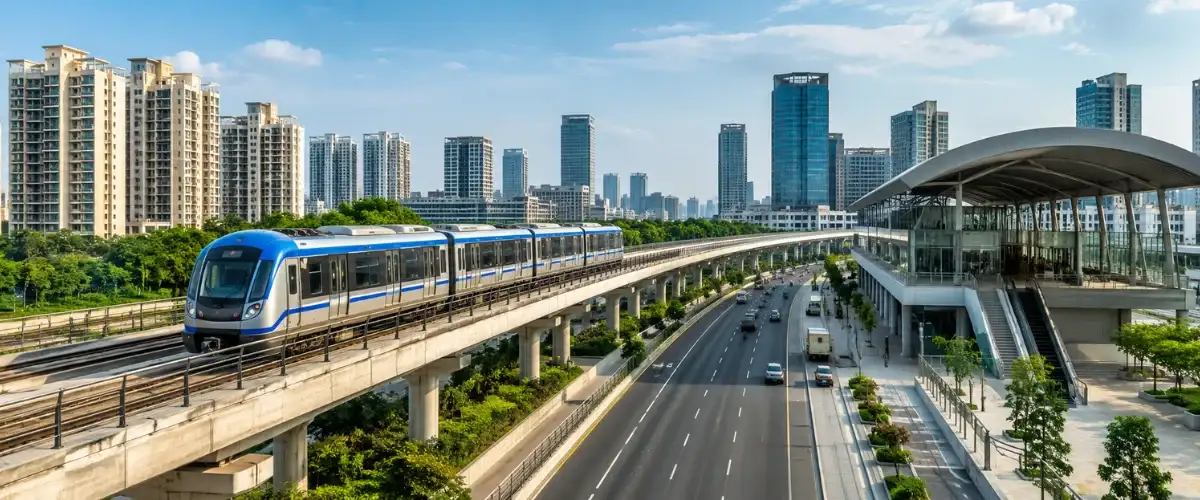
For people considering a home in the city, daily travel can be an important part of choosing where to live. Easy access to railway stations, highways, buses and neighbouring business districts can make regular journeys more manageable.
The city occupies a strategic position within the Mumbai Metropolitan Region (MMR), with established transport routes linking it to Mumbai, Navi Mumbai and nearby suburbs. Understanding these routes can help homebuyers assess how well a particular neighbourhood fits their regular travel pattern.
Railway Access and Suburban Rail
Thane railway station is a major interchange on Mumbai’s suburban rail network. It provides services towards Mumbai as well as destinations across the wider suburban region.
Rail travel can be particularly useful for people heading towards Mulund, Ghatkopar, Kurla, Dadar and central Mumbai. The station also serves as an important point for connecting with other parts of the metropolitan transport network.
For a prospective resident, however, station proximity should not be measured only in kilometres. The actual route from the residential development, access to feeder transport and walking conditions can all affect the overall journey.
Major Roads Serving the City
Road-based travel forms another important part of the city’s transport network. Several major corridors pass through or around the region, connecting residential areas with commercial centres and neighbouring suburbs.
The Eastern Express Highway provides a significant north-south route between Mumbai and Thane. It is relevant for people travelling towards eastern Mumbai and central parts of the city.
Ghodbunder Road serves as an important east-west corridor, linking several residential neighbourhoods with routes towards western Thane and the wider MMR.
For motorists, the most useful question is often not how close a development is to a highway, but how easily the main access road can be reached during regular travel hours.
Thane-Belapur Road Towards Navi Mumbai
Residents travelling towards Airoli, Rabale, Ghansoli, Kopar Khairane and Navi Mumbai can benefit from access to Thane-Belapur Road.
The corridor serves several established employment and industrial areas, making it relevant to professionals whose workplaces are located on the Navi Mumbai side.
Actual journey times can vary depending on the starting point, traffic volume and time of day. Buyers should therefore assess the route from the specific residential project rather than treating the entire corridor as having identical travel conditions.
Local Buses and Short-Distance Travel
Major railway and road corridors handle longer journeys, while local transport helps residents complete shorter trips within the city.
TMT bus services, BEST routes in relevant areas, auto-rickshaws and app-based cabs provide additional options for reaching stations, markets, workplaces and other nearby destinations.
This last-mile connection can be particularly useful when a home is not within convenient walking distance of a railway station.
During a site visit, check where the nearest bus stops and auto-rickshaw stands are located. The availability of these services can give you a better idea of how easily you can move around without depending entirely on a private vehicle.
Metro Development and Future Travel Options
Metro infrastructure is adding another layer to the region’s public transport network.
Mumbai Metro Line 4, also known as the Wadala-Kasarvadavali corridor, is designed to connect important areas of Mumbai and Thane. Its planned alignment includes multiple stations serving the Thane side.
For homebuyers, it is important to separate existing transport options from proposed or developing infrastructure. A future station should not be treated as an operational facility.
When a residential project refers to upcoming metro access, check the latest official project information and current construction status before using it as a factor in your decision.
Routes Towards Mumbai and Navi Mumbai
Thane’s position allows residents to travel in several directions depending on their destination.
Someone working in central Mumbai may find suburban rail more relevant, while a professional travelling regularly towards Navi Mumbai may place greater importance on road access through the Thane-Belapur corridor.
People travelling towards areas such as Bhandup, Mulund, Powai, Ghatkopar and Airoli may use different combinations of rail, road and local transport.
This is why transport convenience should always be assessed according to your own regular destination rather than using a single measure for the entire city.
Test the Journey Before Choosing a Home
Online maps are useful for understanding distances, but they cannot show every practical part of a daily journey.
Before finalising a residential property, try travelling from the project towards your workplace or frequently visited destination during your usual travel hours. Check the time taken to reach the main road or railway station, availability of local transport, traffic conditions, walking distance and ease of changing between transport modes.
A real-world trial can provide a clearer picture of the daily journey than an estimated travel time shown on a map.
Understanding the Transport Network
The usefulness of Thane connectivity depends on where you need to go and how you prefer to travel. Railways, major highways, local buses and developing metro infrastructure each serve different travel requirements.
For someone searching for a home in Thane, the practical approach is to match the surrounding transport network with their workplace, routine and preferred mode of travel.
Explore residential projects and location details at www.kalpataruthane.com or contact +91 9860949793 for project-related information.